Soviet Union, January 1991: Three Days to Exchange the Large Notes
At midnight on 23 January 1991, Soviet 50- and 100-ruble notes stopped being legal tender. The exchange window and its limits, dated and sourced.
01
The Hour
Midnight
Wednesday 23 January 1991. Moscow.
At midnight, the Soviet Union's 50- and 100-ruble notes stopped being legal tender. The presidential decree had been announced on Tuesday, the day before.
Holders had three days to exchange them for smaller notes or newly issued large ones. Workers could exchange the equivalent of a month's salary, up to 1,000 rubles, and pensioners their monthly pension, up to 200.
Withdrawals from savings accounts were capped at 500 rubles a month. Anyone holding more in large notes had to prove the money was acquired legally.
02
The Sequence
Reconstructed to the day. The record gives one clock time, midnight; everything else is dated, not timed.
22 Jan
Tuesday. Mikhail Gorbachev's decree on the large notes was announced. That night, Prime Minister Valentin Pavlov said on television that the reform was aimed at black marketeers and speculators dealing in high-denomination notes.
23 Jan
Midnight. The 50- and 100-ruble notes ceased to be legal tender. The Washington Post put a 100-ruble note's worth at anywhere from 5 to 160 dollars, depending on the rate applied.
23 Jan
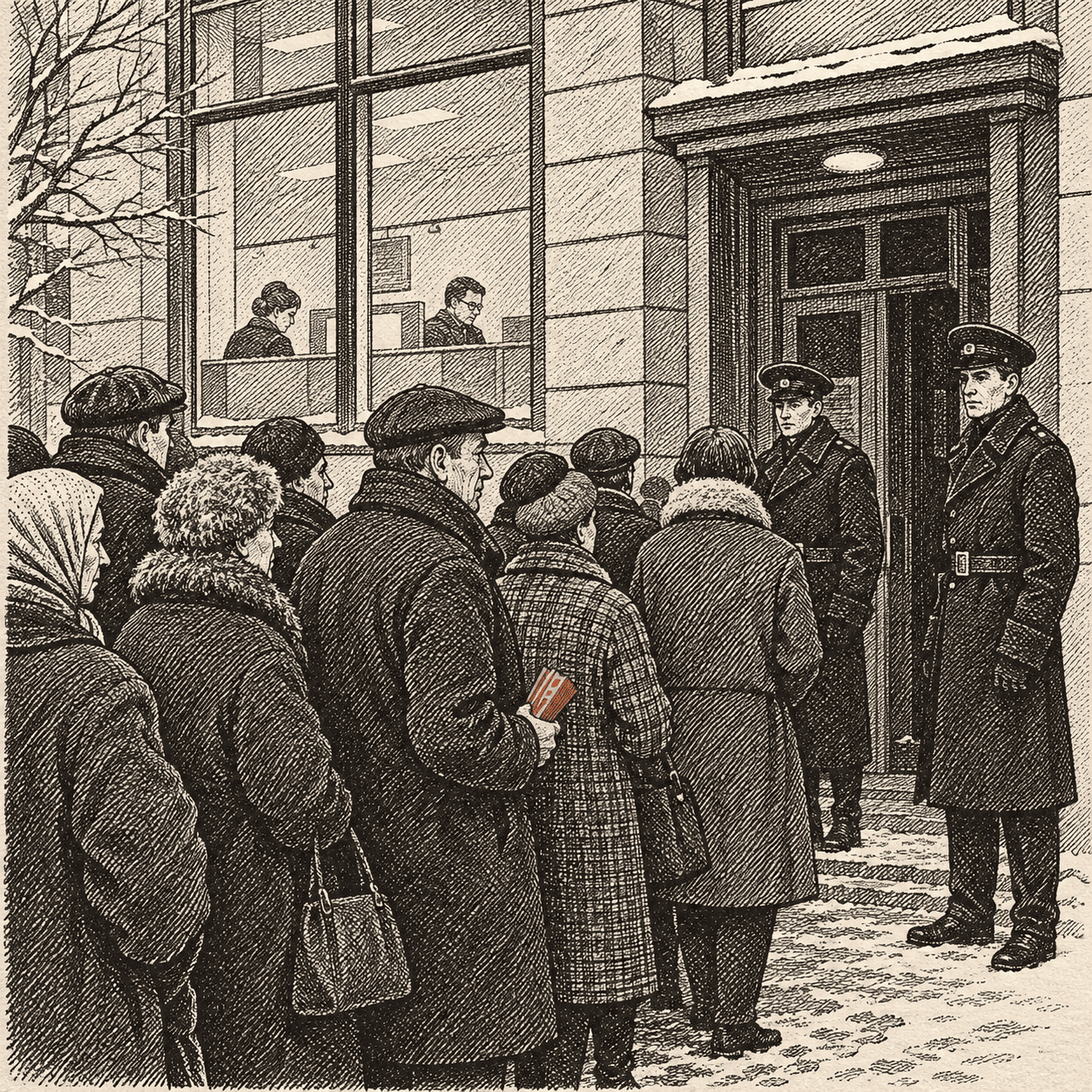
Morning. Police were summoned to keep order at banks and savings institutions across the country. Hundreds of citizens crowded the savings institutions, and arguments broke out in the lines outside.
23 Jan
On the first day of the window, the branches were still waiting for detailed government instructions on the terms of exchange. The decree limited exchange in most cases to one month's salary.
23 Jan
Larger sums went before commissions of workers' representatives and KGB agents, who were to decide whether the money had been honestly obtained. The KGB was also authorized to seize banks that failed to comply.
23 Jan
Anna Surgina, a 78-year-old retiree, could exchange 200 rubles, her monthly pension. The Post judged her chances of recovering another 800, kept for her grandchildren's education, dubious.
23 Jan
Erburat Aliev, an Azerbaijani collective-farm worker who had sold his car, took 13,000 rubles to a bank. High-denomination notes were already trading on the black market for a fraction of face value.
23 Jan
Estonia's central bank director called the decree part of a war between the Kremlin and the republics. His bank was considering its own currency in place of the ruble.
13 Feb
The Baltimore Sun reported pensioners who had spent hours shivering in endless lines to exchange their savings. Pavlov now credited the 22 January decision with foiling what he described as a Western plan to dump rubles; critics doubted it.
03
The Hidden Dependency
The visible break was at the savings counter. Behind it sat a record-keeping question: how much each person could show was theirs.
The exchange limit was tied to documented pay. A worker could convert up to a month's salary and a pensioner up to a month's pension, and anything above had to be shown to a commission to have been acquired legally.
For Anna Surgina, her pension set the figure at 200 rubles. Notes she had saved beyond that line had no automatic route back into money that worked.
The banknote stayed in the holder's hand; what converted it was the salary or pension record standing behind it.
04
What Still Worked
Smaller notes
Denominations below 50 rubles stayed legal tender and in everyday use. Holders could exchange the large notes for them, or for newly issued large notes, within the limits set by the decree.
Savings withdrawals
Savings accounts kept paying out through the reform, capped at 500 rubles a month for each depositor, so money already held in an account stayed reachable within that limit.
Pension-sized exchange
Pensioners could convert notes up to their monthly pension, within a ceiling of 200 rubles.
05
On the Record
The Document
22 January 1991
The presidential decree, as Time and The Washington Post reported its terms.
The 50- and 100-ruble notes ceased to be legal tender. Workers had three days to exchange the equivalent of a month's salary, up to 1,000 rubles; pensioners, their monthly stipend, up to 200.
Anyone holding larger amounts in big notes had to prove they were acquired legally. Depositors could withdraw no more than 500 rubles a month. The KGB was authorized to seize banks that failed to comply.
06
The Pattern Library
#1
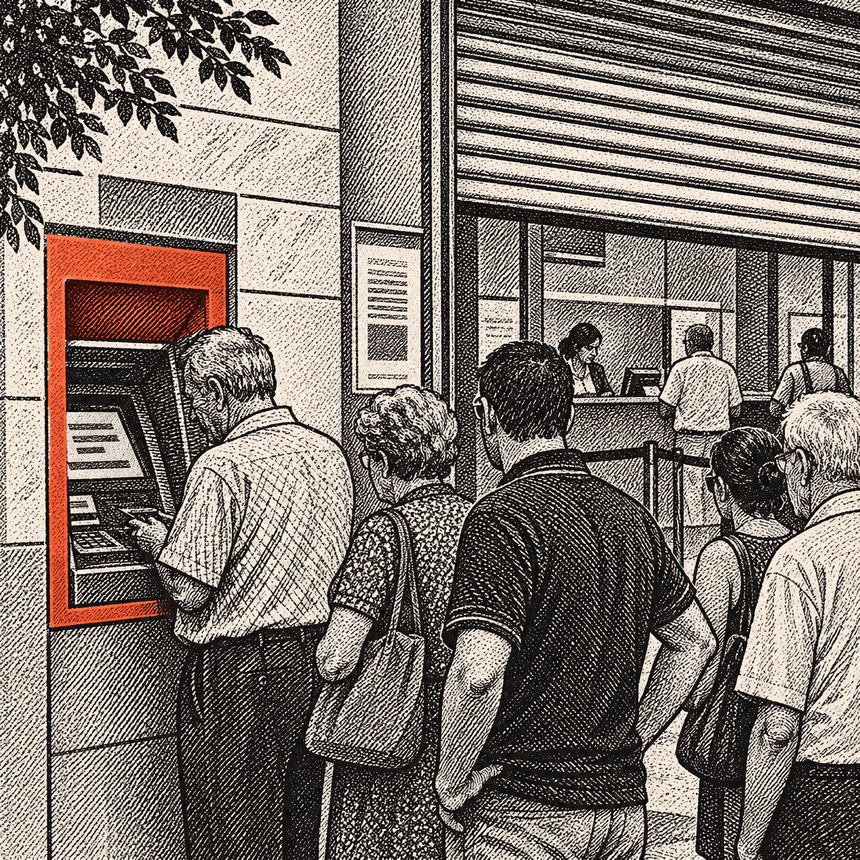
Cash machines continued to dispense through the bank closure under daily withdrawal limits that were imposed or lowered during the closure, and keeping the machines stocked with notes became a constraint.
Observed: Cyprus 2013, Greece 2015.
#2
Suppliers stopped extending their usual payment terms and asked to be paid before shipping or on delivery.
Observed: Iceland 2008.
#3
Queues formed at branches within a day of the official announcement that set off the episode.
Observed: Northern Rock 2007, Soviet Union 1991.
CHANGED TODAY: #3 refined and Soviet Union 1991 appended. 'Within hours' became 'within a day', because the Soviet lines formed the morning after the decree was announced.